


If you are taking blood thinners or anticoagulants it is best to consult your physician or naturopathic doctor as reishi might prevent the medications from working properly. People who have diabetes should also be cautious with consuming reishi because it might lower blood sugar levels. If you are interested in using this product and are someone who is pregnant or nursing, under the age of 18, or currently taking prescription medication, please consult with your health practitioner before use.
Turkey Tail 8:1 Capsules
$38.65 CAD$42.95 CAD
turkey tail for gut, microbiome and immune health, concentrated 8×
- 60 capsules, each 500 mg of turkey tail extract plus 30 mg of lion's mane. 60 days at one a day
- 8:1 dual extract (hot water and organic grain alcohol): 4,000 mg dried-mushroom equivalent per capsule
- 100% organic fruiting body. No mycelium, no grain, no fillers
- Health Canada NPN 80112726
- Source of fungal polysaccharides with immunomodulating properties.
60-day supply about $0.64 a day
- Health Canada
NPN on every bottle - 100% organic
fruiting body - no mycelium
no fillers - Canadian company
Vancouver, BC
Free expedited shipping across Canada (1 to 3 business days), no minimum.
why turkey tail
-
8× concentrated
eight kilograms of fruiting body in every kilogram of extract
-
100% fruiting body
Trametes versicolor, the mushroom itself, no mycelium or grain
-
over 40% polysaccharides
alpha- and beta-glucans, standardized, with every batch tested
-
Health Canada NPN 80112726
reviewed and issued by Health Canada; a source of fungal polysaccharides with immunomodulating properties
-
organic, non-GMO, vegan
hypromellose capsule, nothing else added
in short
-
what it is
Turkey tail fruiting body, dual extracted and concentrated eight times: 500 mg per capsule, a 4,000 mg dried-mushroom equivalent, standardized to over 40% polysaccharides, plus 30 mg of lion's mane 1:1.
-
how it fits a day
One capsule with breakfast, every day. A daily habit matters more than the hour. Sixty days a bottle.
-
where it comes from
Trametes versicolor grows in fans on fallen hardwood around the world and has centuries of use in East Asian tradition. We source the fruiting body alone, to our standards for potency and purity.
why Purana

Every Purana label says the same few things, and each one was a decision. Here is what they mean.
-
the mushroom, not the mycelium
100% fruiting body, sourced to our own standards for potency and purity. The grain a mushroom is grown on never makes it into a Purana capsule.
-
concentrated, then named
our 8:1, 10:1 and 16:1 dual extracts name their compounds, and every input batch is tested for potency and purity.
-
a Health Canada NPN for every formula
each product was reviewed by Health Canada, formula, manufacturing and claims, and issued its own Natural Product Number, printed on the label and linked on this page.
-
Canadian, and plain about it
organic, non-GMO and vegan, made in a GMP-certified facility for a Vancouver company. Inputs are tested for heavy metals, pesticides and microbes. Nothing added that a label would have to explain.
how we compare
feature
Purana turkey tail 8:1
a typical mushroom supplement
mushroom part
100% fruiting body
often mycelium grown on grain, grain included
concentration
8:1 dual extract, 4,000 mg dried-mushroom equivalent per capsule
often 1:1, or an unconcentrated powder
extraction
hot water and organic grain alcohol
often hot water only, or none
actives named and tested
polysaccharides over 40%
often no percentages and no named compounds
the capsule
hypromellose, nothing else
often fillers or flow agents
Health Canada NPN
NPN 80112726 on the label
look for an NPN on the label
supply per bottle
60 days
often 30 days
“Typical” describes practices that are common across mushroom supplements sold in North America. It is not a comparison with any named brand, and products vary. Hold any label against these rows.
what's inside
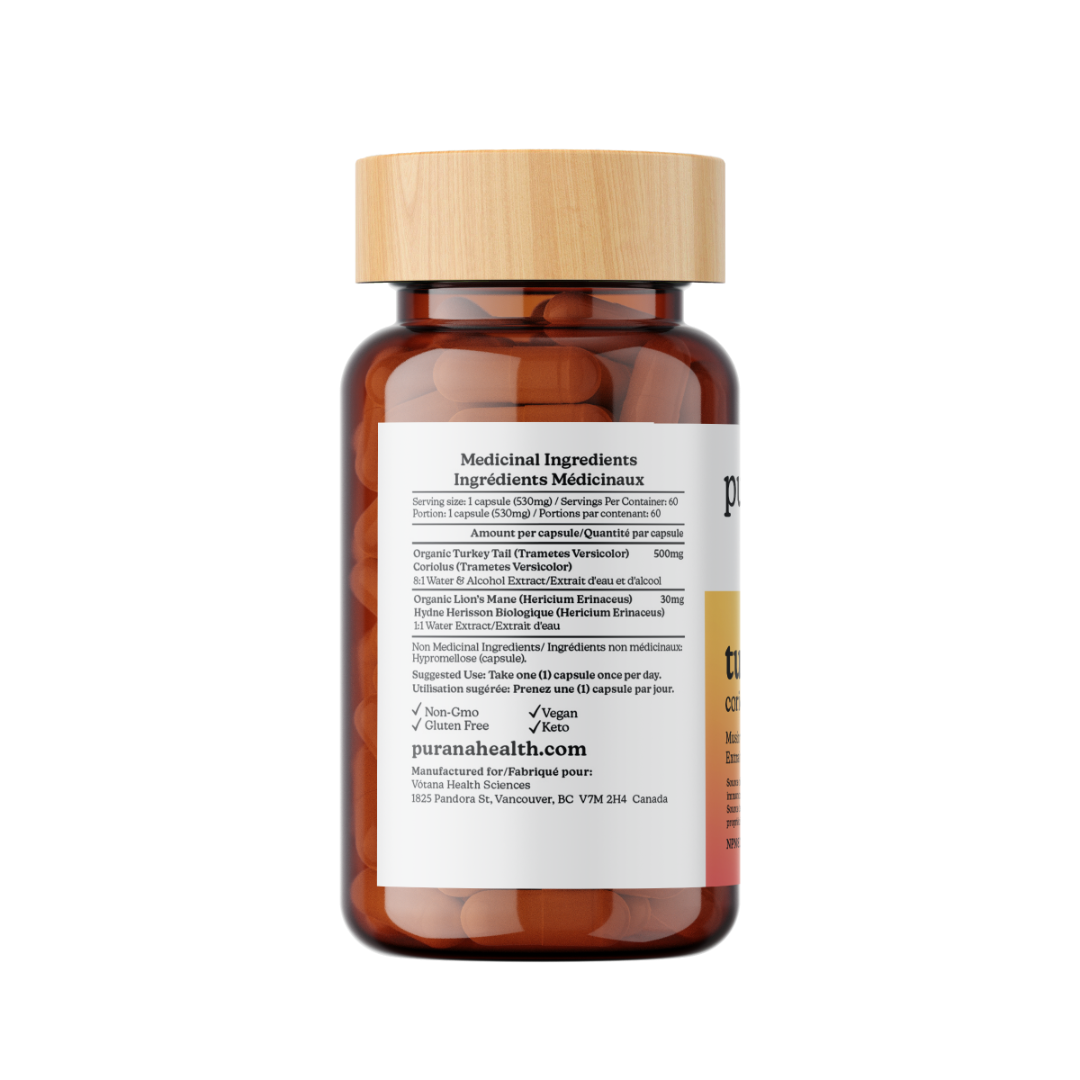
- medicinal ingredients
- Trametes versicolor (turkey tail) fruiting body, 500 mg per capsule, plus Hericium erinaceus (lion's mane) 30 mg
- extract
- 8:1 dual extract (hot water and organic grain alcohol), 4,000 mg dried-mushroom equivalent
- actives
- polysaccharides over 40%
- non-medicinal
- hypromellose capsule
- recommended dose
- adults 18+, one capsule once daily
- Health Canada NPN
- 80112726
- per container
- 60 capsules
Actives vary a little from batch to batch. The figures here are minimums or typical values, and every input batch is tested.
what to expect
Mushroom extracts work through slow biology. The habit is the product. Here is the shape of the first two months.
-
day 1
start with food
One capsule with breakfast. Nothing to feel yet, and that is normal: the first days are about the habit, not a sensation.
-
week 2
the habit holds
Same time, same meal. By now the capsule is part of breakfast rather than a decision. Keep going.
-
day 30
the research window opens
Most human trials of these mushrooms run four to twelve weeks of daily use. Notice how your days are going.
-
day 60
one bottle, your own evidence
A full bottle is sixty days of daily use. Decide on that, not on a week. If it has earned its place, reorder or subscribe.
Effects are built, not switched on. This is guidance on consistency, not a promise of results.
the research
-
human trial
healthy volunteers, gut microbiome
Turkey tail polysaccharopeptide acted as a prebiotic in a randomized trial in healthy volunteers, shifting the gut microbiome.
read the study -
analytical
compounds in turkey tail
Chromatography and spectroscopy identified sterols, triterpenes and other compounds in turkey tail fruiting-body extracts.
read the study -
analytical
beta-glucan versus grain starch
Analytical methods separate true beta-glucan from the grain starch found in mycelium-on-grain products.
read the study
Research is reported as research, about the people or cells in each study. It describes the ingredient, not a promise about this product.
your ritual
how to take
One capsule, once daily, with food.
when to take
With breakfast, every day. A daily habit matters more than the hour.
pairs well with
what's inside
Trametes versicolor fruiting body, 500 mg per capsule as an 8:1 dual extract (4,000 mg dried-mushroom equivalent), polysaccharides over 40%, plus Hericium erinaceus 30 mg. Capsule: hypromellose.
read the label What 8:1 means: eight kilograms of fruiting body go into every kilogram of this extract. That is why a 500 mg capsule carries a 4,000 mg dried-mushroom equivalent, the number printed on the label. Short answers below.
short answers
What does 8:1 mean?
Eight kilograms of dried turkey tail fruiting body are concentrated into one kilogram of extract. Each 500 mg capsule therefore holds the equivalent of 4,000 mg of whole mushroom, which is what the label states.
Why is there a small amount of lion's mane in this?
Each capsule carries 30 mg of lion's mane 1:1 alongside the turkey tail, as listed on the NPN and the label.
Fruiting body or mycelium?
Fruiting body only. The fruiting body is the mushroom itself. Mycelium is the root-like network it grows from, usually cultivated on grain, and mycelium products often contain that grain. There is no mycelium, grain or filler in a Purana capsule.
How and when do I take it?
One capsule once daily, with food. Most people take it with breakfast.
Does it have a Health Canada NPN?
Yes. NPN 80112726, issued by Health Canada after a review of the formula, the manufacturing and the claims. The NPN wording is: a source of fungal polysaccharides with immunomodulating properties.
What is in the capsule besides the extract?
The extract, and a hypromellose capsule shell (plant-derived, vegan). No fillers, flow agents or additives.
Can I take it with medications?
Talk with your health care practitioner before starting any supplement, especially if you are pregnant or breastfeeding, taking medication, or managing a health condition.
Natural health products with a Health Canada NPN are not intended to diagnose, treat, cure or prevent any disease.


60 capsules per bottle | 60 day supply | 500mg per capsule (8:1 dual water/alcohol extract, 4,000 mg dried-mushroom equivalent)
made with organic ingredients
100% fruiting bodies | no fillers or additives
up to 50% polysaccharides | NPN 80112726
Suggested Use Take one (1) capsule once daily.
Read more about turkey tail below or
Benefits of turkey tail
Why take turkey tail?
- to strengthen the immune system
- to improve gastrointestinal health
- to support healthy lungs
Turkey tail mushrooms have many benefits including immune system support and gastrointestinal support. It is a great way to improve overall health.
Turkey Tail contains polysaccharide peptide (PSP) and polysaccharide krestin (PSK). PSPs have been shown in animal and human studies to support healthy immune function at the cellular level. Both PSP and PSK have the ability to modulate inflammation, immunity, and hematopoiesis (the formation of blood cells).
They strengthen macrophages, a type of white blood cell that ingests foreign material and debris within the body. Such a function may have the potential for treating cancer, chronic fatigue syndrome, multiple sclerosis, and other conditions associated with immune compromise.
PSPs enhance the immune system by stimulating cytokine synthesis. Cytokines are small proteins that regulate immune function and communicate between cells during an immune response - which is useful in conditions such as common cold and flu, upper respiratory tract infections and gastric ulcers. It also contains an anti-ulcer compound that inhibits gastric secretion and acid formation (which can cause discomforts such as heartburn and indigestion), as well as antioxidant activity for helping prevent cancer.
Turkey tail supports the lungs by reducing inflammation and fluid accumulation. It may help decrease coughing, shortness of breath, and airway spasms. Studies show it to be effective for bronchitis and other respiratory conditions. Turkey Tail also helps to prevent excessive production of histamine so that the immune system doesn't overreact to foreign invaders.
In recent years, a growing body of research suggests that Turkey Tail may be beneficial in supporting the immune system to strengthen the body's first line of defence against a host of modern ailments.

Our Story, Our Promise
Turkey Tail (Trametes Versicolor) is a white-rot fungus that has been used for centuries in Asia and now the West is rediscovering this traditional tonic. Turkey Tail grows on a wide range of trees including alder, apple, ash. beech, birch, chestnut, cottonwood, elm, eucalyptus, fir, oak and poplar.